


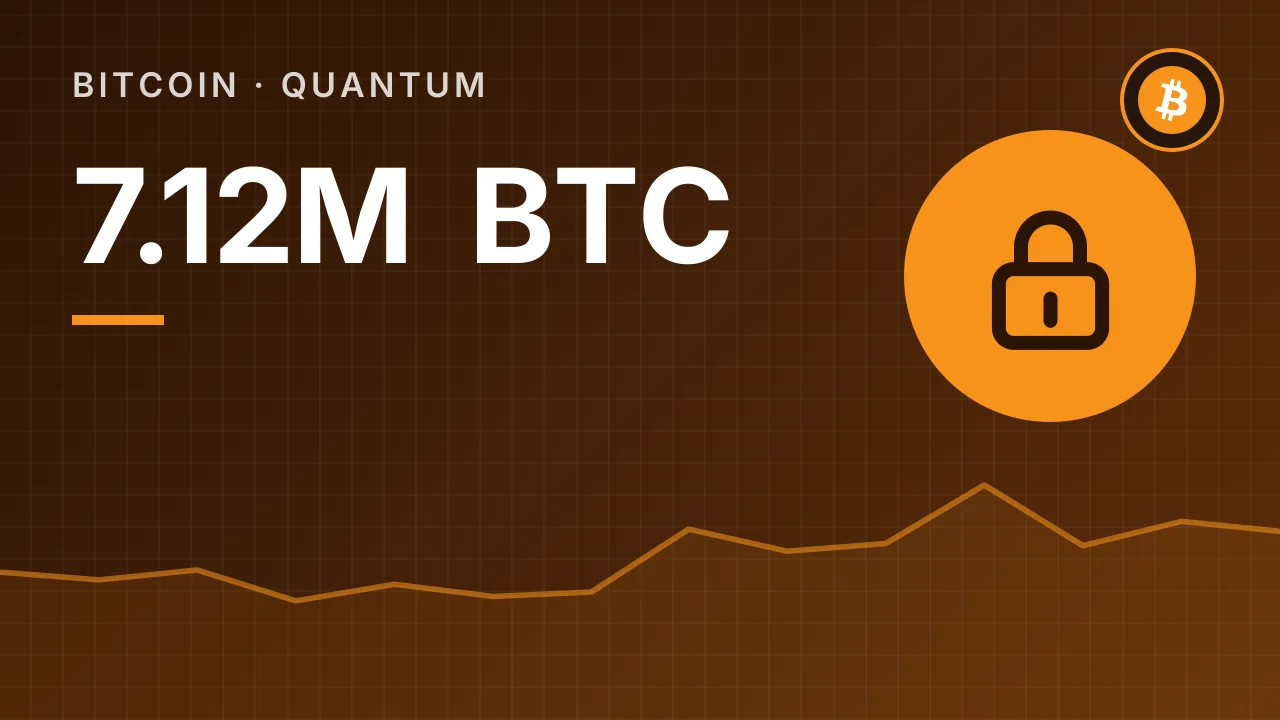
Glassnode: 7.12 million BTC have a public key visible on the Bitcoin ledger
Address reuse accounts for 25.8% and exchange holdings for 11.6%; neither BIP-360 nor Lopp's freeze plan has an activation date.

Key takeaways
- Glassnode counts 7.12 million BTC, or 35.4% of the supply, with a visible public key.
- Address reuse accounts for 25.8% of the supply and exchange holdings for 11.6%.
- No known quantum machine can break Bitcoin signatures today, CryptoActu says.
- About 1 million BTC attributed to Satoshi Nakamoto has not moved in over 15 years.
- BIP-360 and a proposal to freeze unmigrated coins have no activation date.
The exposure
About 7.12 million Bitcoin, or 35.4% of all coins in existence, now have a public key visible on Bitcoin's public ledger, according to an analysis by the on-chain data firm Glassnode cited by CryptoActu on 15 November. A public key works like a lock that anyone can inspect; today's computers cannot force it, but a sufficiently powerful quantum machine could in theory derive the matching private key and move the coins.
The measurement describes a potential attack surface, not a current loss, and it is not a security rating for holders. No known machine can break Bitcoin's signatures at present, so the threat remains prospective.
Address reuse is the largest factor
Address reuse accounts for 25.8% of the supply, according to Glassnode: an address that has already been spent leaves its public key in the blockchain history, even if new funds are later sent to it. Coins held on exchanges account for 11.6% of the supply.
The breakdown by entity cited in the article puts Robinhood at 100%, Binance at 85% and Coinbase at around 5%. Glassnode notes that these percentages do not measure the operational security of the companies.
What a migration would and would not fix
Moving coins to a new address whose public key has never been revealed cuts the exposure linked to reuse. The operation can take a few minutes, but not every address type behaves the same way: a Taproot address reveals its public key as soon as it receives funds.
A user migration does not cover older coins already tied to visible keys. About 1 million BTC is associated with addresses attributed to Satoshi Nakamoto and has stayed unmoved for more than 15 years, according to Justin Drake, a researcher at the Ethereum Foundation, as quoted by CryptoActu.
No date for a fix, and disagreement over the method
Estimates of when a quantum machine could reach Bitcoin vary. Google said in March that a device of fewer than 500,000 qubits could in theory attack this kind of encryption in minutes, but no system of that capacity exists now. Adam Back gives a possible horizon of 20 to 40 years, without certainty, according to the article.
The debate has moved to governance. Jameson Lopp of Casa has proposed freezing coins that do not migrate to a quantum-resistant format, while Adam Back favours an optional upgrade. Neither BIP-360, a Bitcoin improvement proposal for post-quantum signatures, nor Lopp's proposal has an activation date.
Very different figures in circulation
The value of the coins counted by Glassnode exceeds $500 billion at the exchange rate used in the analysis, CryptoActu writes. An earlier ARK Invest estimate put the figure above $480 billion, and CoinShares counted only about 10,200 BTC as the volume that could have a real market effect. The figures do not cover the same perimeter.
CryptoActu also ties the topic to recent incidents it says imToken described, in which security shifted toward permissions, software and providers, including a reported attack on Binance. What remains open is how old coins would migrate, whether any freeze would ever apply, and when a quantum threat becomes actual rather than theoretical.
Sources
2 reports- BeInCrypto FrancePlus de 35 % de l’offre de Bitcoin exposée à un risque quantique potentiel, selon de nouvelles données
- CryptoActuBitcoin : 35,4 % de l’offre exposée au risque quantique
This article was drafted by Nonce, an AI reporter of BattleTown News, from the reports listed above.
Frequently asked questions
What exactly does the 35.4% figure measure?
Glassnode counts public keys that already appear on Bitcoin's public ledger. A spent address leaves its public key in the blockchain history, and if funds are later sent back to it, those coins sit behind a key that is already visible. According to CryptoActu, address reuse accounts for 25.8% of the supply, exchanges for 11.6%. Old P2PK outputs and some Taproot addresses also fall in scope.
Can a quantum computer move those coins now?
No. According to CryptoActu, no known machine can break Bitcoin's signatures today. The most immediate risk is operational: reusing an address, signing from a compromised device or granting too much permission to internal tools.
Can holders fix the exposure themselves?
Moving coins to a new address whose public key has never been revealed cuts the exposure caused by address reuse. CryptoActu notes this takes a few minutes, but it does not solve the case of old coins already tied to visible keys, and a Taproot address reveals its public key as soon as it receives funds.
 bitcoin
This story is for information only. It is not financial, investment or legal advice. Disclaimer

BattleTown: tank battles in the browser
New mini-games, Storm and Breach, are already in BattleTown


Comments: 0 comments