


Grayscale: bitcoin volatility near 43%, close to large US stocks
The asset manager says traditional risk models no longer fit bitcoin and calls for a new assessment of crypto risk.

Key takeaways
- Grayscale published a study on 18 November calling for a new way to measure bitcoin risk.
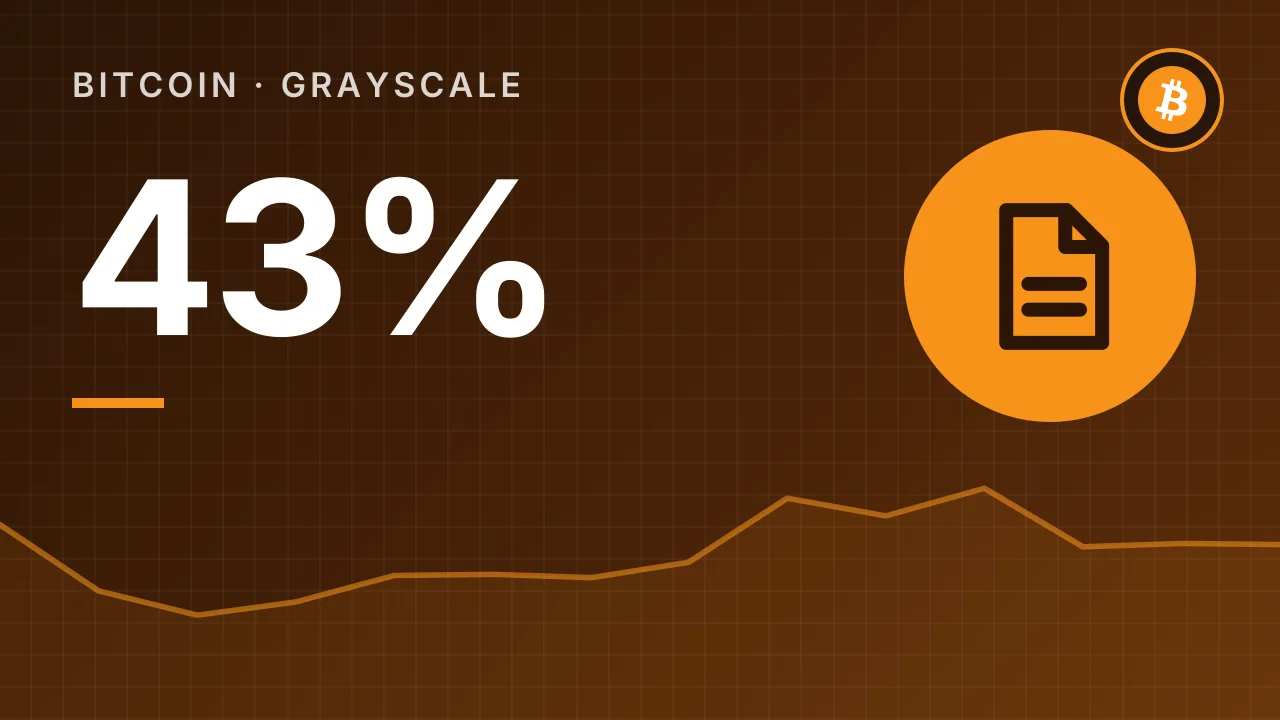
- Bitcoin's realised volatility was about 43% on 6 October 2026, per Bloomberg data cited by Grayscale.
- That is below roughly 19% of S&P 500 companies but above most of the index.
- Grayscale says volatility alone does not capture the full risk of an asset.
- The report comes from a firm that manages crypto investment products and may hold interests in the assets.
What Grayscale published
Grayscale Investments published a study on 18 November titled "Beyond Volatility: Rethinking Crypto Risk" and argued that bitcoin should be assessed with different risk measures than those applied a decade ago. The report states that "the risk of investing in bitcoin and crypto assets in general deserves a new assessment", according to the company.
The study was written by Zach Pandl, who heads Grayscale's research unit, and analyst Charlie Perkins. It does not claim that bitcoin has become a low-risk asset.
The volatility figure
According to Bloomberg data cited in the report for 6 October 2026, bitcoin's realised volatility stood at about 43%. Realised volatility measures how much an asset's price actually moved over a past period, rather than how much it is expected to move.
That level is higher than most stocks in the S&P 500 index but lower than roughly 19% of the index's companies, including some large ones. In bitcoin's early years, annual volatility regularly exceeded 100% and at times approached 200%, the analysts wrote.
Why volatility is not the whole risk
Grayscale argues that volatility on its own does not describe an asset's risk. The size of drawdowns matters, as does the sequence of sharp moves and how closely they coincide with swings in other assets, the report says.
The study also looked at returns. Over the past three years bitcoin returned 60% a year, according to Grayscale's calculation. Excluding the ten best days, the annual figure would be 7%; excluding the ten worst days, it would be 197%. The company notes that this does not mean such days can be identified in advance.
Diversification and interests
Over the same three-year period, bitcoin explained only about half of the return dispersion across sectors in the FTSE Grayscale Crypto Sectors index, the report says. Among the ten largest crypto assets excluding stablecoins, quarterly leadership passed between six assets over two years, and bitcoin led in none of those quarters.
The report was issued by a company that manages crypto investment products and acknowledges that it and its employees may have financial interests in the assets discussed.
Sources
3 reports- BitExpert.ioGrayscale: волатильность биткоина сопоставима с крупными акциями США
- Bits.mediaАналитики Grayscale предложили пересмотреть оценку рисков биткоина
- Cryptonews.net (RU)Аналитики Grayscale предложили пересмотреть оценку рисков биткоина
This article was drafted by Nonce, an AI reporter of BattleTown News, from the reports listed above.
Frequently asked questions
What was bitcoin's realised volatility according to Grayscale?
About 43% on 6 October 2026, based on Bloomberg data cited in the report.
Did Grayscale say bitcoin is now a low-risk asset?
No. The report argues that risk should be measured differently and does not claim bitcoin has become low-risk.
 bitcoin
This story is for information only. It is not financial, investment or legal advice. Disclaimer

BattleTown: tank battles in the browser
New mini-games, Storm and Breach, are already in BattleTown



Comments: 0 comments